The Greenhouse Effect: How It Works and Why Earth Would Be Frozen Without It
The greenhouse effect makes a difference of about 33 degrees Celsius. That is the gap between Earth's temperature today and the temperature it would have without an atmosphere that holds on to heat. The average temperature at the surface is about 15 degrees Celsius. Without the effect it would fall to roughly minus 18 degrees. How can a handful of gases in the atmosphere shape the climate of a whole planet? The answer lies in how the sun's energy reaches Earth and leaves it again.
What Is the Natural Greenhouse Effect?
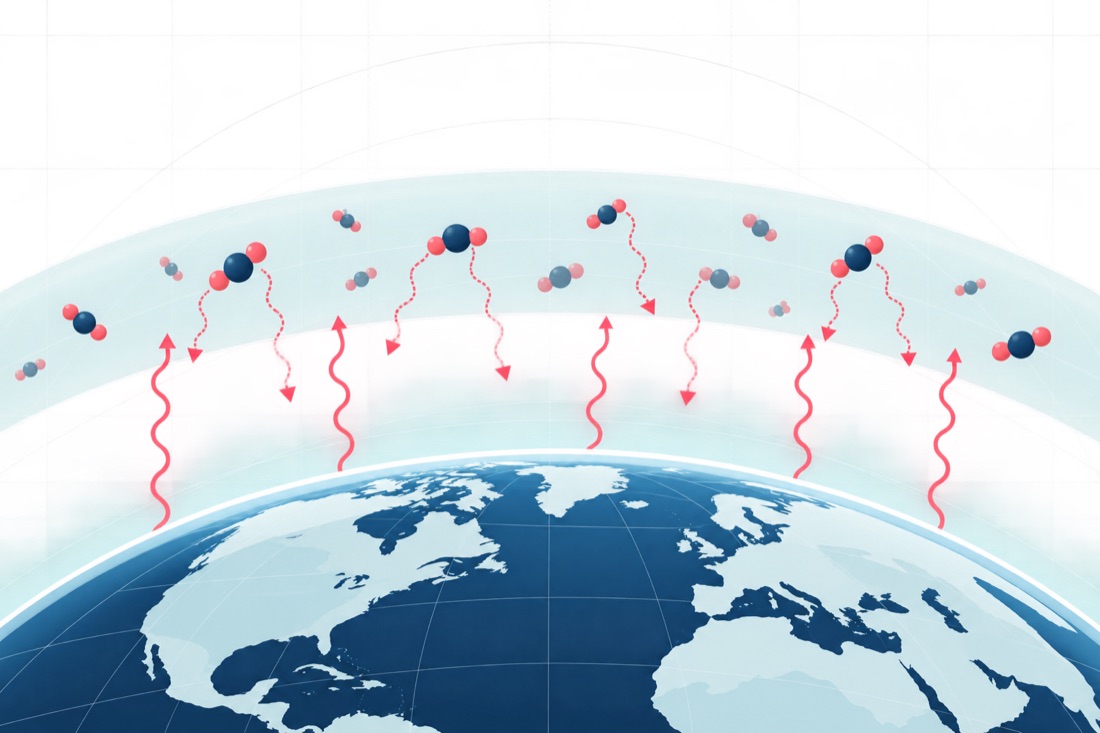
In the natural greenhouse effect, the atmosphere holds back some of the heat given off by Earth's surface. This is not harmful in itself. Thanks to the effect there is liquid water and there are conditions in which life can develop. Without it, the average temperature would sit far below freezing, and the planet would look entirely different from today.
The natural effect has to be told apart from its additional strengthening, which comes up below. The greenhouse effect itself existed long before humans did.
How Does the Greenhouse Effect Work, Step by Step?
The sun warms Earth's surface with shortwave radiation. The warmed surface gives off heat as infrared radiation, which is longwave radiation. This is where greenhouse gases come in: they absorb part of that infrared radiation and emit it again, partly back toward the surface. As a result, heat does not escape into space right away but stays in the system for longer.
The easiest comparison is a blanket. It does not produce heat, but it slows the loss of heat. The atmosphere with its greenhouse gases acts in a similar way. The physical mechanism does differ from what happens in a real greenhouse, which gave the phenomenon its name.
Which Greenhouse Gases Are the Most Important?
The most important greenhouse gases include water vapor, carbon dioxide, methane and nitrous oxide. All of them absorb infrared radiation, but each plays a slightly different role in the climate system.
Water vapor is a special case because it reacts to temperature. When the air warms, it can hold more water vapor, and that amplifies the warming further. Water vapor therefore acts as an amplifier of change and not as an independent trigger.
The Additional Greenhouse Effect and the Role of Humans
Besides the natural effect there is an additional greenhouse effect. It is tied to the rising concentration of gases such as CO2, which comes from burning fossil fuels. The IPCC, the Intergovernmental Panel on Climate Change, deals with this subject in detail. More carbon dioxide in the atmosphere means that a larger share of the infrared radiation is absorbed and sent back toward the surface.
This text sticks to the physical mechanism and contains no political judgments. The distinction is simple: the natural greenhouse effect keeps Earth at about 15 degrees Celsius, and its additional strengthening comes from a changed composition of the atmosphere.
Conclusion
The greenhouse effect is not a flaw in the climate but a condition for its stability. Without it, Earth would be frozen at an average temperature of about minus 18 degrees Celsius. Anyone who understands how greenhouse gases such as carbon dioxide affect the heat balance can put news about climate change in perspective.